The short answer fits in a sentence. You register yourself with the casting companies that specialise in background performers, with photos and your measurements, then you answer fast when they call.
The full answer means understanding three things the ads never say: what an extra actually is, what the unions require depending on the production, and why speed matters more than your look. In our survey of 148 actors in Quebec, 20% described themselves as beginners doing mostly background work. This guide is for them.
What is background work?
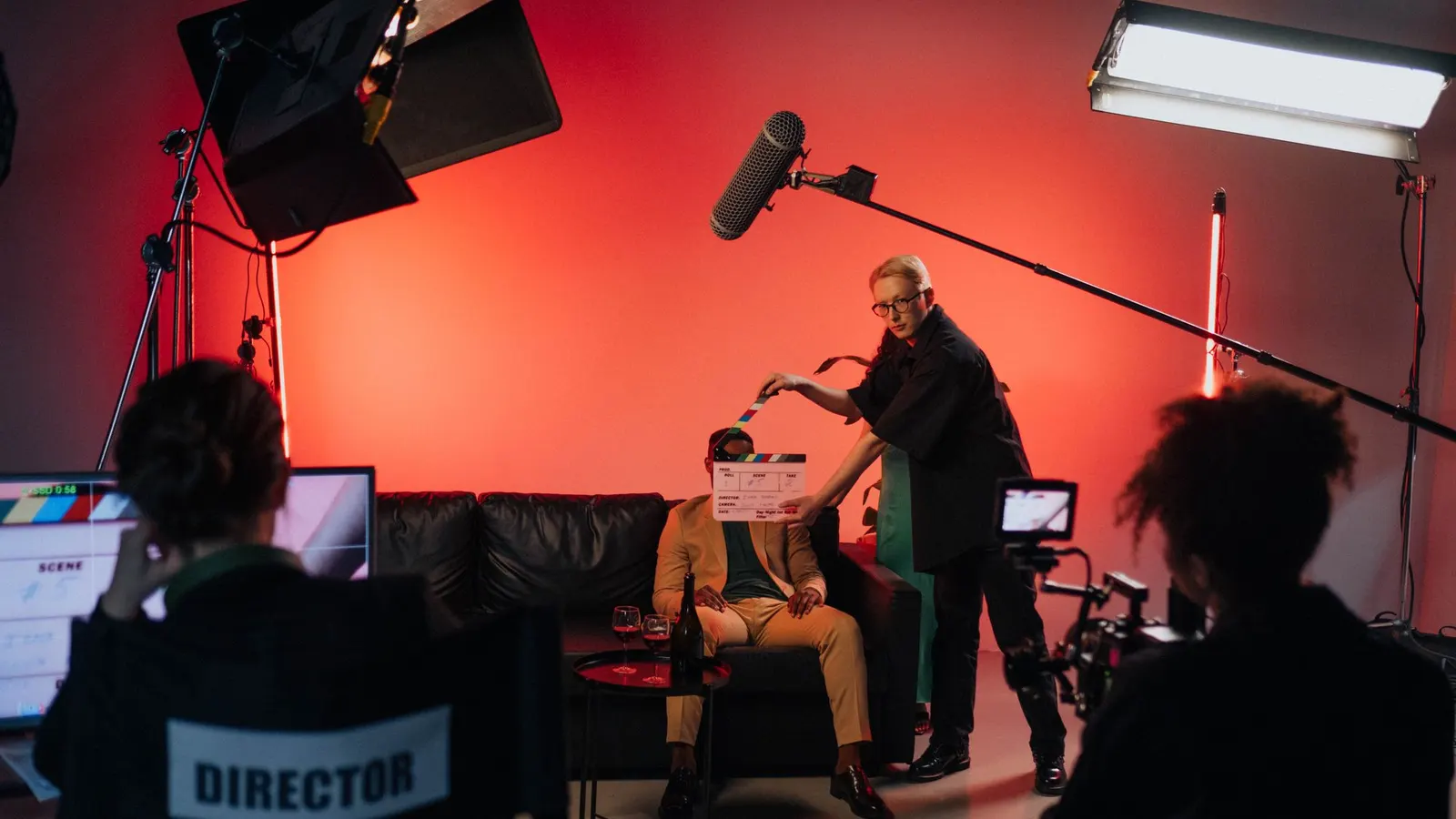
A background performer (an extra) appears on screen with no lines and no named character: the diners in a restaurant, the passers-by on a street, the crowd at a concert, the staff in an office. Without them, any scene shot in a public place would look empty.
The UDA collective agreement for television and film, which covers French-language productions in Quebec, distinguishes two kinds of background work:
- Atmosphere extra (figurant d'ambiance): being present in the scene, with no particular action.
- Specialised extra (figurant spécialisé): a specific skill is required, such as driving a period car, dancing, skating or playing an instrument. It pays more.
- One step up, the silent third role (troisième rôle muet) is a real part with no lines but an action that matters to the scene.
Do you need to be in a union to do background work?
This is where most guides get it wrong. On a production covered by the UDA agreement, the first 25 background performers of each shooting day must be UDA members (active or apprentice). In the regions, when the shoot is more than 75 km from UDA head office or more than 50 km from one of its sections, that number drops to the first 5.
| Situation | Non-member accepted? |
|---|---|
| Large crowd scene, beyond the first 25 extras (UDA) | Yes |
| Regional shoot, beyond the first 5 (UDA) | Yes |
| Extra under 16 | Yes, it is a listed exception |
| A specific casting need no member can fill | Yes, it is a listed exception |
| English-language or American production shot in Quebec | Yes, and it is the biggest volume for beginners |
| Non-union production (web, student, some commercials) | Yes |
The practical consequence: if you are starting with no union status, register with the companies that cast English-language productions too. Montreal hosts many American shoots, and that is often where new background performers get their first days.
Where to register for background work in Quebec
There is no official registry. You register directly with the casting companies that recruit extras for productions. The main ones in Montreal:
- FJB Casting (Figuration Julie Breton), specialised in background work since 1999.
- MFK Casting, which took over the work of Figuration Carole Dionne.
- Casting Quarters, very present on English-language productions.
- Montreal Casting, also active on productions shot in English.
ACTRA Montréal publishes an up-to-date list of the background casting directors its members work with. It is the best way to check that a company is real and active before sending it your photos.
How to sign up to be an extra in a movie
- Recent, accurate photos: one headshot, one full-length, no filters. They must look like you today. An outdated photo is the first reason people get sent home from set.
- Your exact measurements: height, weight, clothing and shoe sizes. Wardrobe dresses you from these numbers.
- Your specifics: tattoos, driver's licence, car (and its model), pets, instruments, sports, languages. These get you called for specialised work.
- Your real availability and how far you will travel.
- Your status: UDA or ACTRA member, permit holder, or non-member.
Be wary of any agency asking for hundreds of dollars to register or requiring a photo shoot with its own photographer. Small registration fees exist at some companies, but an extra is paid by the production; you do not pay to work.
How to be an extra in a specific movie or series
It is one of the most common searches, and the answer disappoints: you do not pick your production. Shoots are confidential, working titles change, and extras are recruited by the casting company hired for the job, sometimes the night before. The only way to raise your odds is to be registered with several companies, with a complete profile, and to answer within the hour when a call goes out.
How much does an extra get paid?
On a film covered by the UDA-AQPM agreement, the minimum for an atmosphere extra is $224 for an 8-hour day since May 24, 2026, which is $28 an hour, and $42 per overtime hour. A specialised extra gets at least $292 a day. Television, commercials and ACTRA productions follow their own rate sheets.
On a non-union production the rate is set by the production and can be much lower. Always ask for the rate, the expected hours and how you will be paid before you accept. In our survey, 48% of respondents had passed on a call because it did not pay enough, and several complained about calls that never mentioned pay at all.
A day of background work, concretely
- Call time is early, often before sunrise, and it is not negotiable.
- You will wait a lot. A 10 to 12-hour day can hold one hour in front of the camera. Bring something to read and a charger.
- Bring several outfits as instructed. Avoid logos, pure white, all black and fine stripes, which look bad on screen.
- Silence is the rule during takes, and photos on set are forbidden. Posting a picture from a shoot can get you dropped from a company's list.
- Repeat exactly the same action on every take: same path, same timing, same gesture. That is what gets an extra called back.

Senior extras, and registering a child
Senior background performers are among the most sought-after profiles. Productions constantly need people aged 55 and over to make scenes look real, and they find fewer of them than young adults. If you are retired and available on weekdays, you have a real advantage.
For a child, parental consent is mandatory, a parent accompanies them on set, and extras under 16 are exempt from the UDA membership requirement. A serious agency never asks for money up front to represent a child.
The Access Plan
Go from background work to your first auditions in 30 days
The six-line profile that sorts a casting call in five seconds, the 90-second test against fake calls and 4 emails ready to copy. 12 pages, free.
One email, not ten. Unsubscribe in one click.
By sending your address, you agree that Castflow emails you this document and keeps you posted on what's new. Privacy policy.
After background work: joining ACTRA or the UDA
- On the English side, ACTRA Montréal offers AABP status (ACTRA Additional Background Performer) to people who can prove 15 days of background work in the previous 12 months and are Canadian citizens or permanent residents.
- On the French side, a non-member hired on a UDA production works as a permit holder (permissionnaire), and those permits add up towards apprentice status.
- Specialised background work and silent roles are the next steps: that is where your specifics (sport, instrument, language) make the difference.
If your goal is auditions, the guide to landing your first auditions in Quebec explains the UDA loop and where contracts come from. And to stop missing calls that go out the night before, Castflow for actors follows published casting and background calls and only shows you the ones that match your profile and region.