
Most talent agencies still run on a patchwork of tools that were never designed to work together. Availability lives in Google Calendar, profiles in drives or PDFs, conversations in email, and follow-ups in Excel. At a small scale, it can hold. But as soon as an agency manages several dozen talent, the system starts to crack.
The problem isn't just organizational: it becomes operational. When a casting director expects a fast answer and you have to check three different platforms before confirming availability, every minute lost cuts your chances of landing the contract.
What really slows agencies down today
Beyond roster size, every agency eventually hits the same operational frictions:
- Scattered data — the same talent exists in five different places, never quite up to date.
- Unreliable availability — impossible to confirm a slot without a series of back-and-forths.
- Responses that are too slow — by the time you've gathered the information, the opportunity has already gone elsewhere.
- Manual submission tracking — you lose track between castings sent, followed up and confirmed.
- A high risk of error — double bookings, the wrong version of a portfolio, a forgotten follow-up.
"The real problem isn't a lack of opportunities. It's the time wasted managing them."
Better organization directly changes performance
When all the data is centralized in a single platform, the workflow becomes far smoother. Agents instantly see which talent is available, which castings are active, which profiles match a brief and which submissions are waiting on a follow-up.
Instead of spending their day managing administrative chaos, they focus on what truly creates value: human relationships, negotiations and developing talent. The top-performing agencies aren't always the ones with the biggest roster — they're often the ones that respond fastest and work with the most reliable information.
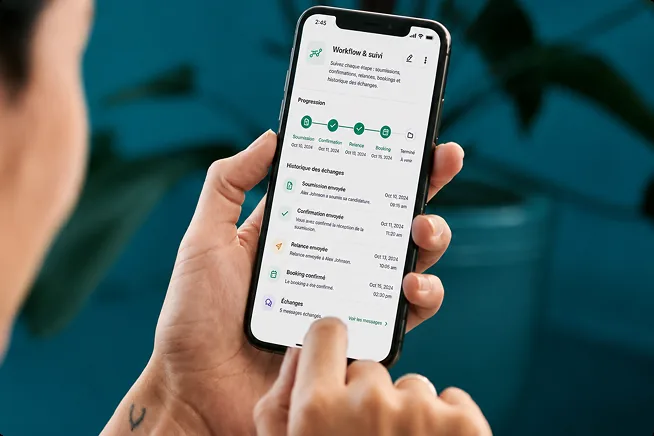
The steps to modernize an agency's workflow
Modernizing an agency doesn't mean replacing everything overnight. The goal is to gradually reduce operational frictions. Here's what usually makes the biggest difference:
- Map the real bottlenecks of your team before choosing a tool.
- Centralize the data talent, availability and opportunities in a single source of truth.
- Connect your channels (calendar, email) so availability stays up to date automatically.
- Automate repetitive tasks : follow-ups, submission statuses, profile updates.
- Measure responsiveness — response time is the metric that weighs most on contracts.
Agencies that structure their workflow save time everywhere: fewer errors, less back-and-forth, less operational stress. And above all, they become far more responsive to casting directors.
When information is available in seconds and teams work in a clear environment, decisions get simpler, turnaround shrinks and opportunities are handled before the competition. That's exactly where an agency gains a real edge.