
Ask ten agencies: what was your callback rate last quarter? You will get ten polite silences. It isn't sloppiness — answering requires cross-referencing an inbox, a spreadsheet and two people's memory.
And yet a talent agency is a conversion machine. Opportunities come in, submissions go out, a fraction comes back as callbacks, a smaller fraction becomes a booking. The moment you measure those steps, an agency stops running on instinct — and, more importantly, it stops confusing "we're working hard" with "we're working well."
The funnel, in four stages
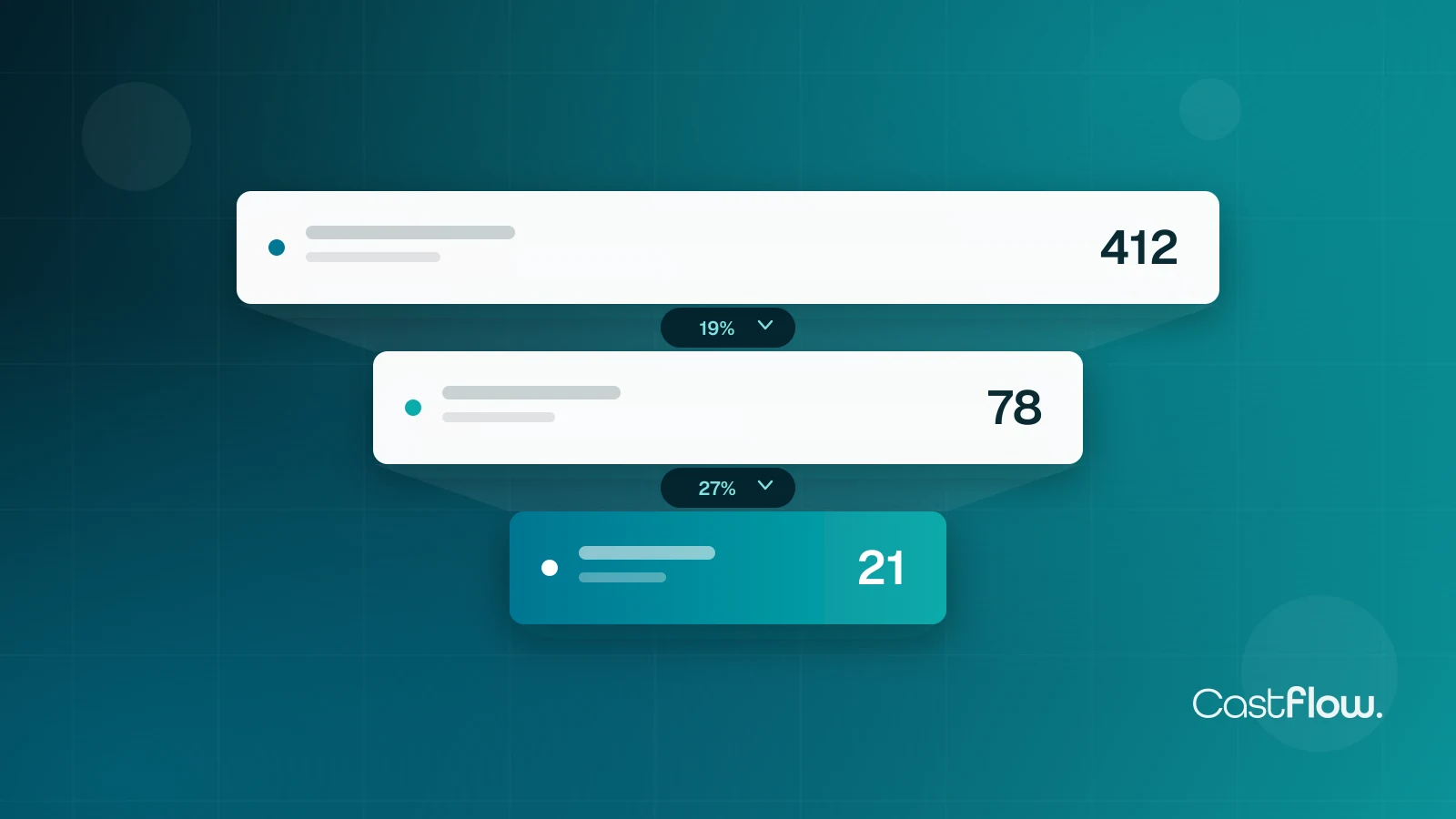
It starts with a simple structure. Four steps, in order:
- Opportunities received — the casting calls that reach you, from any source.
- Submissions sent — the profiles you actually put forward.
- Callbacks — the talent invited to audition or called back.
- Bookings — confirmed contracts.
Every step between stages is a rate, and every rate answers a different question. That's where it gets useful: one number in isolation tells you almost nothing, but the shape of the funnel tells you exactly where to intervene.
The five numbers
| Metric | Calculation | What it reveals |
|---|---|---|
| Response rate | Opportunities acted on ÷ opportunities received | Your market coverage. How much passes under the radar. |
| Callback rate | Callbacks ÷ submissions | The quality of your targeting. The most revealing of the five. |
| Booking rate | Bookings ÷ callbacks | Final conversion: preparation, availability, negotiation. |
| Time to submit | Hours between receipt and send | Your speed — usually the most underrated factor. |
| Roster coverage | Talent submitted ≥ 1× ÷ total roster (90 days) | How much of your roster is dormant. The most uncomfortable number. |
1. Callback rate is your compass
If you track only one, track this one. It measures how accurately you read a casting call: did I put forward the right people?
A low rate — say under 10% — rarely means your roster is weak. It means you're submitting too wide. Thirty profiles for one role isn't generosity: it's an admission that nobody read the breakdown to the end. And casting directors notice long before you do.
2. Booking rate is about something else entirely
A strong callback rate with a weak booking rate is a completely different diagnosis. Your targeting works — the right people are getting in the room. It breaks down after that: thin preparation, sides sent too late, schedule conflicts discovered at the worst moment, or simply talent showing up without knowing what's expected of them.
Two ratios, two opposite action plans. Same initial feeling that things aren't landing.
3. Time to submit, the factor nobody counts
Measure the hours between a call arriving and your first submission going out. The first batch received gets read closely; the sixth gets skimmed. An agency that answers in three hours is playing a different game than one that answers the next morning, with an identical roster.
It's also the easiest metric to improve, because it depends on your organization rather than your talent.
4. Roster coverage, the uncomfortable number
Over ninety days, what percentage of your talent was submitted at least once? The answer is often blunt: an agency believes it represents a hundred and twenty people and keeps thirty of them working.
This number has a direct effect on retention. Talent who receive no submissions for six months don't complain — they leave. And they usually leave without saying so.
5. Response rate on opportunities
How many casting calls actually land in your field of view, and how many do you act on? The gap between the two is your blind spot. It is nearly always wider than estimated, because you never count what you didn't see.
"Volume flatters the ego; rates tell the truth. An agency that doubles its submissions without moving its callback rate has simply doubled its workload."
Reading the numbers together
In isolation these ratios are trivia. Cross-referenced, they're diagnoses:
- Low callback + high volume → you're spraying. Tighten targeting before adding talent.
- High callback + low booking → a preparation or availability problem, not a selection problem.
- Good rates + few bookings → your funnel is healthy but too narrow at the top: you're short on opportunities, not on performance.
- Good overall rates + low coverage → your results rest on a handful of people. That's a risk, not a strength.
Segment, or the averages will lie
A single blended average mixes realities that aren't comparable. Commercials, scripted work and voice have neither the same volumes nor the same rates: an 8% callback rate can be excellent in commercials and mediocre in scripted. Segment at minimum by project type and, if you can, by casting director.
That second cut is the most valuable of all. It shows you where your submissions genuinely convert — and therefore which relationships deserve a coffee, and which ones have been costing you time for two years.
The classic traps
- Measuring volume. Submissions sent is the easiest metric to improve and the least useful. The moment you make it a target, it stops being a measurement.
- Concluding too early. A single month means nothing. On fifteen submissions, two extra callbacks swing your rate by 60% with nothing having actually changed. Think in quarters.
- Forgetting the denominator. A booking rate computed only on confirmed callbacks, excluding cancelled auditions, flatters the result artificially.
- Hunting for benchmarks. There is no reliable public baseline for this industry. Your only useful comparison is yourself, three months ago.
How to calculate them without software
You need nothing more than a sheet and twenty minutes a month. Five columns: date, project, talent submitted, callbacks, bookings. One row per casting call. At quarter's end, four additions and four divisions.
It's crude, and it is already infinitely better than instinct. The one condition: fill the row at the moment of submission. Reconstructing three months of data after the fact never works — which is precisely why most agencies measure nothing at all.
Where the tooling actually matters
This is the real argument for a centralized system, and it's more mundane than the usual pitch: when every submission, convocation and reply is recorded as it happens, counting costs nothing. The numbers exist because the process produced them, not because someone found time to compile them on a Friday afternoon.
An agency that knows its five numbers doesn't work harder. It simply knows which of its efforts pay off — and that's usually the difference between growing and burning out.