
In Quebec, a talent agency and a Facebook group are tied: each is where about 3 in 10 actors found their most recent project. That is the central finding of a questionnaire completed by 239 actors between August 26 and September 26, 2026, from background performers to people who make a living from acting.
Nobody had compiled these numbers before: where actors here find their work, what they pay to try, what their agency actually sends them and what makes them pass on a casting call. This article presents all the data, including the findings that complicate our own assumptions.
What stands out from the 239 responses?
- Agencies and Facebook are tied. The most recent project came from an agency for 31% of respondents and from a Facebook group for 30%. Among actors without an agency, Facebook rises to 38%.
- The more established you are, the less work comes from Facebook. Among those who make a living from acting or earn a significant share of their income from it, 76% check the groups, but only 11% found their last project there. Agencies (51%) and casting directors who reach out directly (14%) take over.
- An agency does not guarantee auditions. Among represented actors, 31% received 3 auditions or fewer from their agency in 12 months, and 12% received none. On the other hand, 42% received more than 10.
- A quarter of represented actors pay recurring fees to their agency on top of commission.
- Half spend more than $500 a year on their career. 28% spend more than $1,000 and 10% more than $2,500.
- Two in three respondents had 3 auditions or fewer in the past year. 28% had none.
- A closed industry before a lack of tools. Asked an open question, respondents first named “always the same actors” (21%), the UDA catch-22 (18%) and the scarcity of roles (15%).
Can you trust these numbers?
82% of responses came through Facebook. We say it here, before anything else, because it is the first criticism people raise and it is partly valid.
The questionnaire was emailed to 80 organizations: professional theatre schools, conservatories, CEGEPs (theatre and film programs), community theatre troupes, adult acting classes and voice training studios. It was also shared by an acting teacher, and the UDA received the link. Several institutions declined to circulate it, and those that did mostly reached students and amateur actors. The result: 25 responses through schools and troupes, 16 through the teacher, 196 through Facebook casting groups and a Facebook page, and 2 through other links.
What that changes, concretely:
- The share who check Facebook is inflated. Respondents who arrived through Facebook check the groups at a rate of 89%, those who arrived through schools and troupes at 24%. The “81% check Facebook” in this sample is therefore not an industry-wide figure.
- What the channel cannot have invented. 68 active UDA members and 34 people who make a living from acting or earn a significant share of their income from it came through these groups. Professionals are there, and no recruitment bias can manufacture that.
- We report by segment. Whenever a figure varies by profile, we give it separately for represented and unrepresented actors, or by career stage.
In other words, this study first describes actors who are actively looking for work. It does not claim to describe every actor in Quebec.
Who responded?
Half of respondents do paid contracts from time to time, and only 15% make a living from acting or earn a significant share of their income from it. It is a portrait of the industry as it is: many active people, few who live from it.
| How would you describe yourself today | Respondents |
|---|---|
| I do paid contracts from time to time | 117 (49%) |
| I'm starting out, mostly doing background work | 46 (19%) |
| It's a significant part of my income | 24 (10%) |
| I'm studying acting or film | 20 (8%) |
| I'm a member of a community theatre troupe | 19 (8%) |
| I make a living from it | 13 (5%) |
- Agency: 51% are currently represented, 18% used to have an agency and no longer do, 31% have never had one.
- UDA: 31% are active members, 22% apprentice members, 46% are not members.
- Region: 39% live in Montreal, 19% in Montérégie, 16% in the Laurentians or Lanaudière, 9% in the Quebec City region, 5% in Laval and 11% elsewhere.
- Language: 95% answered in French, 5% in English.
A useful benchmark: in 2025 the UDA reported more than 8,500 active members and 5,100 apprentice members, or about 38% apprentices. Among our respondents who are UDA members, the share is 41%. The UDA also represents singers, dancers and other performers, so the comparison is only indicative.
1. Where does your next contract really come from?
The most recent project came from two sources almost equally: an agency (31%) and a Facebook group (30%). But the answer changes completely depending on whether you have an agency, and on how far along your career is.
| Where the last project was found | All (239) | Represented (122) | No agency (117) | Make a living or significant income (37) |
|---|---|---|---|---|
| My agency sent it | 31% | 56% | 6% | 51% |
| A Facebook group | 30% | 23% | 38% | 11% |
| A friend, a contact, word of mouth | 17% | 8% | 26% | 14% |
| A casting director reached out directly | 9% | 9% | 9% | 14% |
| Casting Workbook, Backstage or another platform | 5% | 1% | 10% | 8% |
| Instagram or TikTok | 1% | 1% | 1% | 0% |
| No project in the past year | 6% | 2% | 9% | 3% |
Three takeaways stand out.
Facebook is the way in, not the destination. Among those who are starting out or mostly do background work, 54% found their last project in a Facebook group. Among those who make a living from acting or earn a significant share of their income from it, it is 11%, even though 76% of them still check those groups.
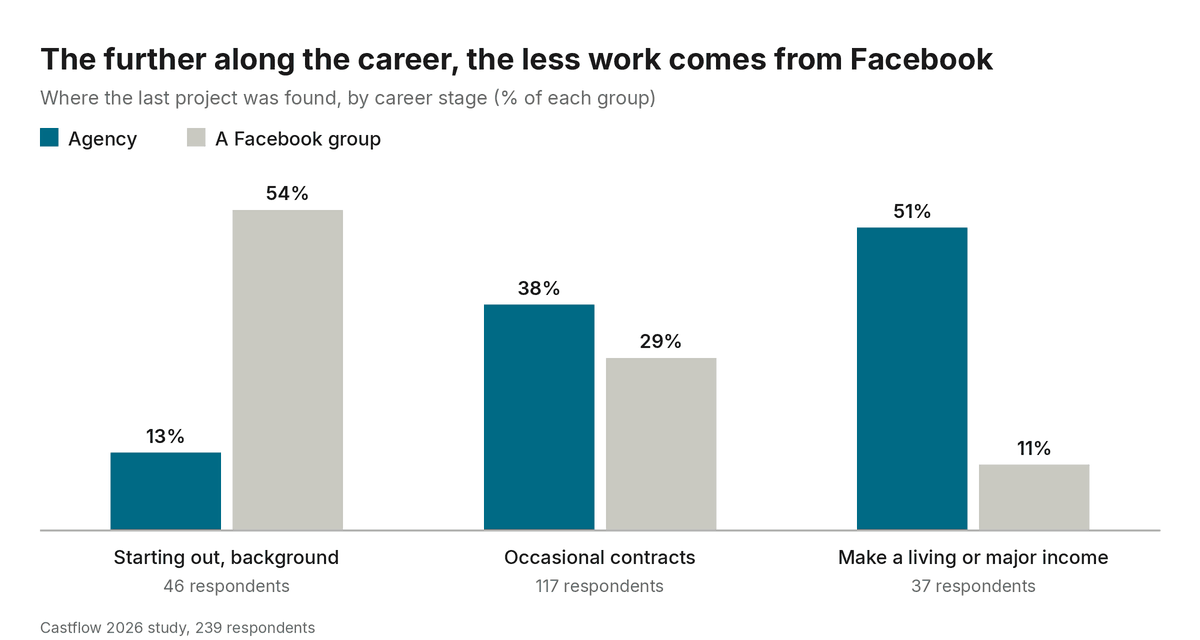
Even with an agency, one project in four comes from elsewhere. 23% of represented actors found their last project on Facebook. Several say so in their comments: they pay commission on contracts they found themselves.
Without an agency, personal networks carry a lot of weight. Word of mouth accounts for 26% of the most recent projects of unrepresented actors, versus 8% for represented actors.
When asked which sources they check regularly (several answers allowed), Facebook groups come first (81%), followed by their agency (37%), word of mouth (34%), Casting Workbook (23%), Instagram or TikTok (16%), another paid platform (11%) and Backstage (10%). The UDA website is mentioned by 4% of respondents. A reminder: the first figure is inflated by how respondents were recruited (see above).
2. What does an agency cost, and what does it send you?
For those who have one, the agency remains the most effective source, but results vary widely: 42% of represented actors received more than 10 auditions from their agency in a year, while 31% received 3 or fewer.
| Auditions sent by the agency in 12 months | Represented actors (122) |
|---|---|
| More than 10 | 51 (42%) |
| 4 to 10 | 33 (27%) |
| 1 to 3 | 23 (19%) |
| None | 15 (12%) |
Results follow career stage. Among represented actors who make a living from acting or earn a significant share of their income from it, 64% received more than 10 auditions from their agency. Among represented actors who are starting out or mostly do background work, it is 27%.
What does it cost?
- Commission: among those who know their rate, 83% pay 15%. The others pay 10% (10 people), 20% (4) or nothing (6).
- Other fees: 25% of represented actors pay recurring annual or monthly fees, 23% have paid for photos or a portfolio, and 15% paid a one-time registration fee. 85% pay commission on their contracts, alone or alongside these fees.
- Total paid in 12 months: 29% paid nothing, 28% between $1 and $300, 18% between $301 and $600, and 20% more than $600. A caveat: the question did not specify whether commission should be included, and the answers suggest some respondents counted it (those who paid more than $600 are also those who received the most auditions). This figure should be read with caution.
Why did some leave?
42 respondents used to have an agency and no longer do. Of the 41 who explained why, 19 describe the same problem: the agency sent nothing or almost nothing, or the actor found their own contracts and still paid commission. The other reasons are life events (6, including two actresses who say they were dropped after a maternity leave), a relationship that deteriorated (5), a poor fit with the agency or its requirements (5), an agency that closed or stopped operating (2) and miscellaneous reasons (5).
“Of the 7 contracts I paid him a percentage on, I had already applied to 5 before he contacted me. I had seen the calls on Facebook.” (translated)
The opposite experience exists too. A respondent who earns a significant share of her income from acting writes that her agent finds her about half of her contracts each year, and that those contracts are very reliable.
Why did some never have one?
Among the 75 respondents who have never had an agency, 59% have never tried to find one, and 11% don't want one. Of the 23 who applied, 16 never heard back and 7 were turned down. Their reasons for not trying come down to three ideas: feeling too inexperienced, not knowing where or how to find a reliable agency, and not doing enough contracts to justify a commission.
See the open Quebec castings, all in one place.
The castings that matter to you, whatever platform they were posted on. Create your free account to see them all.
See the castings3. How much does an acting career cost in Quebec?
Half of respondents spent more than $500 on their career in the past 12 months, and one in ten spent more than $2,500. This money is paid up front, with no guarantee of work.
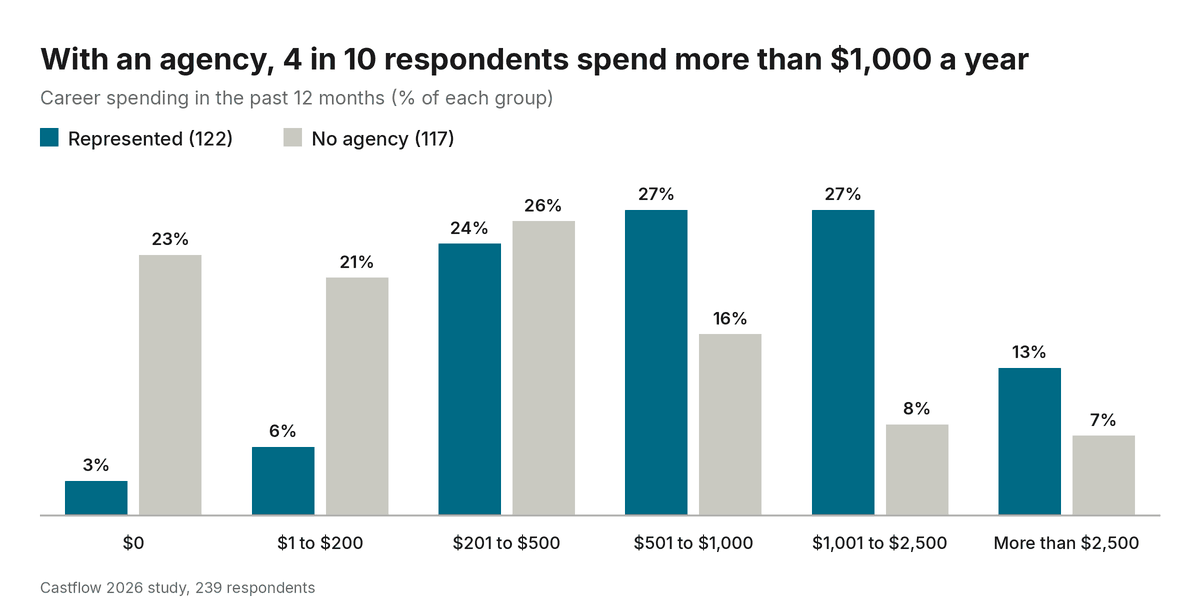
Using the midpoint of each range (and $3,500 for the top one), average spending comes to about $920 a year: roughly $1,220 for represented actors and $610 for actors without an agency. This is an estimate, not an exact measurement.
On what. Among the 208 respondents who spent something, the most common items are travel to auditions (49%), acting classes (46%), photos or a portfolio (45%), a casting platform subscription (41%), agency fees (38%) and self-tape equipment (32%). 29% also checked “other”. In their written comments, several mention union dues, which the questionnaire did not offer as a choice.
Platforms. 93 respondents described their subscriptions. Casting Workbook is by far the most common (51 mentions), usually at $100 to $150 a year. It is followed by Voilà Casting (11 mentions, mostly for voice work), IMDb Pro (9), MFK Casting (8), Actors Access (6), Les Électrons libres (4) and Backstage (4).
Spending without auditioning. Among the 66 respondents who had no auditions in the past year, 21 still spent more than $500 on their career.
4. Why do actors let a casting call go by?
Two in three respondents had 3 auditions or fewer in the past year, even though almost half spend at least an hour a week looking for projects.
| Auditions in the past 12 months | All (239) | Represented (122) | No agency (117) |
|---|---|---|---|
| None | 28% | 17% | 38% |
| 1 to 3 | 37% | 27% | 47% |
| 4 to 10 | 17% | 25% | 9% |
| More than 10 | 18% | 30% | 6% |
Time spent searching. 13% don't look at all, 41% spend less than an hour a week, 35% between one and three hours, and 12% more than three hours. The people who spend the most time are not beginners: 22% of respondents who make a living from acting or earn a significant share of their income from it search more than three hours a week, versus 11% of those who are starting out.
The last casting call they let go
We asked respondents why they did not apply to the last casting call they saw (several answers allowed).
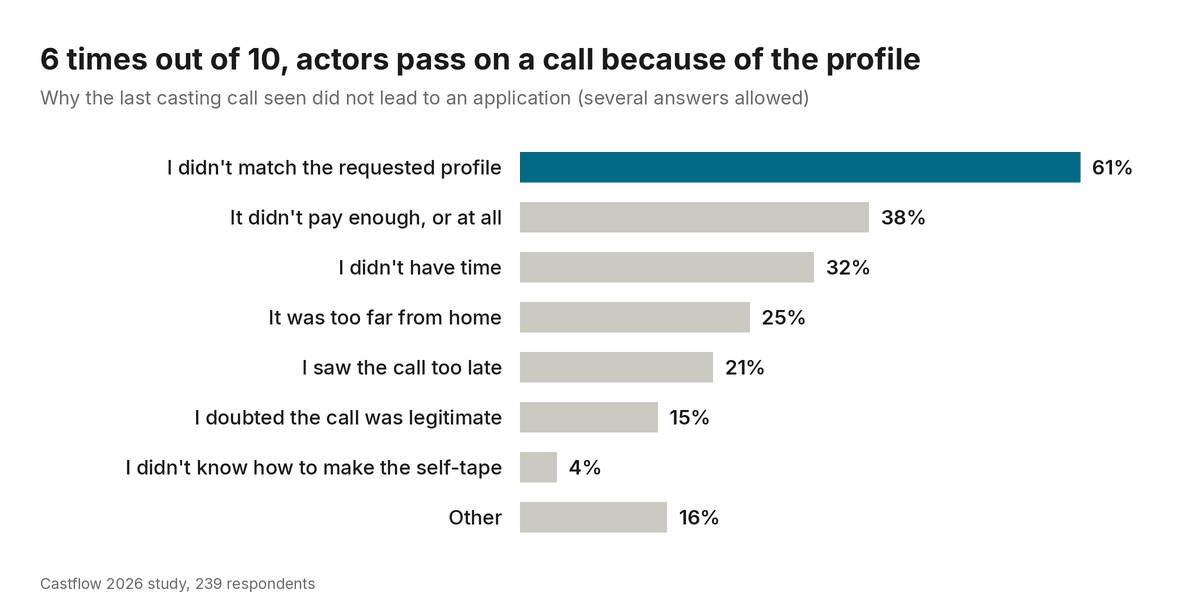
Two gaps stand out. Actors without an agency more often see the call too late (26% vs. 16%), which is consistent with searching by hand across scattered sources. They also more often give up because of distance (30% vs. 20%). On the other hand, not knowing how to make a self-tape is almost never the reason.
5. Have you ever been taken in?
One respondent in ten says they have been taken in by a fake casting call or a casting scam, and 12% are not sure. Add the 15% who passed on a casting call because they doubted it was legitimate, and doubt becomes part of the ordinary search.
The share varies by status: 17% of UDA apprentice members say they have been scammed, versus 10% of non-members and 5% of active members. Having an agency does not fully protect you: 11% of represented actors say they have been scammed.
The 15 accounts left by respondents describe a few recurring patterns:
- Money is requested to secure the role, for example to “confirm” a part in a big American production, to pay the crew or to buy seats for a fashion show.
- Fake agencies charge for representation that never leads to work.
- Fake video-call auditions where the person claiming to cast the project never shows their face and pushes the applicant toward inappropriate requests, up to undressing on camera. Three accounts describe this scenario.
- Impersonation of a well-known brand or production to make the call look credible.
One account shows how long these frauds can last: a respondent says she recognized the same fake casting director, with the same email address and the same method, in an audition her agency at the time forwarded to her a year later, and then in the account of another young woman a few months before the study.
6. What frustrates them most, in their own words?
The last question was open-ended: “What is the most frustrating thing about looking for acting work in Quebec?” No choices were offered. All 239 answers were read and coded one by one, and a single answer could touch several themes.
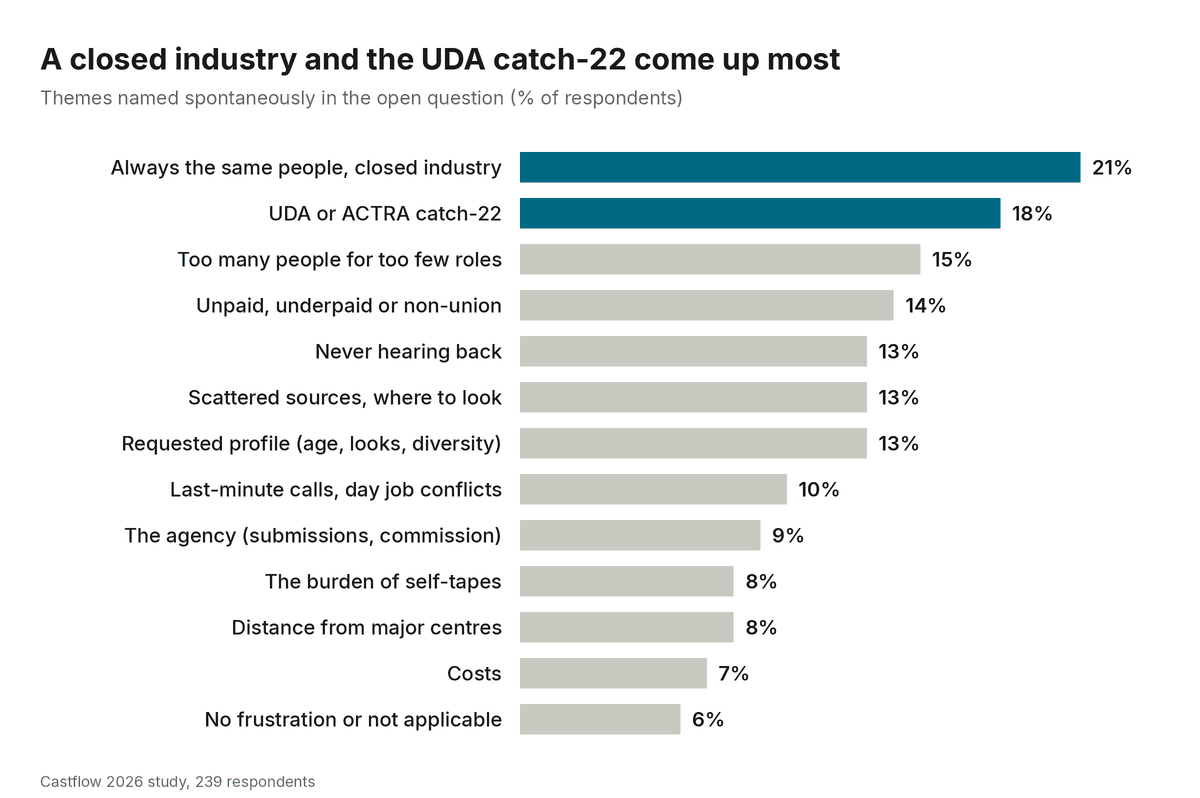
Less than 5% each: vague or incomplete casting calls, doubts about legitimacy and the experience catch-22. Themes change with status. The UDA catch-22 is named by 27% of non-members, versus 8% of active members. Scattered sources, by 21% of non-members, versus 4% of active members. Among active members, “always the same people” dominates (32%), and self-tapes weigh twice as much as in the sample overall (16%).
“It's a bit of a chicken-and-egg situation.” (on access to the UDA, non-member, translated)
“You have to go around the Facebook groups depending on what comes in. It's like going fishing and not coming home with dinner.” (no agency, starting out, translated)
“Never hearing back is one of the most frustrating things in the world.” (active member, represented, translated)
“I feel like I'm judged more on my self-tape technique than on my acting.” (non-member, no agency, translated)
“Why pay a trained actor when you can get anyone for free?” (active member, represented, translated)
“I can't just not show up at work and risk losing my steady income.” (on last-minute calls, apprentice member, translated)
One voice goes against the grain and deserves to be reported. A respondent who has since moved into directing for film and stage writes that she doesn't use casting groups, and that work comes first through networking: meeting people, showcases, classes with casting directors. She adds that, in her view, the number of auditions has dropped sharply since the pandemic while the number of performers has grown.
What can't this study prove?
This study describes 239 people who chose to respond. It cannot be used to claim that the same proportions apply to all actors in Quebec.
- No margin of error. Respondents selected themselves. The American Association for Public Opinion Research (AAPOR) considers it misleading to report a margin of error for this kind of sample, so we don't report one.
- Recruitment mostly through Facebook. 82% of responses came through this channel, which inflates anything related to Facebook use (see the box at the top).
- Self-selection. People with something to say about their job search probably responded more than others. A microphone giveaway was offered to participants, which may have attracted less relevant respondents; a skill-testing question and the filtering described below limit that effect without eliminating it.
- Small subgroups. 13 respondents make a living from acting, 24 earn a significant share of their income from it, and 12 answered in English. Figures for these groups indicate a trend, not a measurement.
- Answers from memory. Amounts and audition counts cover 12 months and rely on respondents' recall.
- Spending in ranges. Average spending is estimated from the midpoint of each range.
- An ambiguous question. The question on fees paid to the agency did not specify whether commission should be included.
- Coding done by us. Open-ended answers were coded by a single member of the Castflow team. Another reader might have drawn some lines differently.
- A declared interest. Castflow builds tools for talent agencies and for actors, so we have an interest in some of these findings. That is why the questionnaire and the anonymized data are published, and why results that don't support our case are reported alongside the others.
The study also does not measure actors' income, nor the total number of working actors in Quebec.
Methodology
- Conducted by: designed, funded, run and analyzed by Castflow (9566-9446 Québec inc.), with no outside sponsor.
- Target population: anyone who acts or wants to act in Quebec, with or without an agency, UDA member or not, from hobbyist to professional. A first question let respondents describe their situation; people who don't act were filtered out.
- Mode: anonymous web questionnaire of about 4 minutes, available in French and English. The path was conditional: agency questions varied depending on whether the person was represented, used to be, or never had been.
- Fieldwork dates: August 26 to September 26, 2026.
- Recruitment: non-probability sample. The link was posted in Facebook casting groups and on a Facebook page, and emailed to 80 organizations between August 27 and September 15: 9 professional schools and universities, 11 CEGEPs (theatre programs), 13 CEGEPs (film programs), 29 community theatre troupes, 14 adult acting schools and classes, and 4 voice training studios. Each link carried a code showing which channel each response came through.
- Incentive: a draw for a DJI Mic Mini 2 microphone among participants, no purchase necessary, with a skill-testing question. 29 respondents chose not to enter.
- Cleaning: 248 questionnaires received. 6 people who don't act and don't want to were removed, leaving 242 complete questionnaires. 3 people who answered twice with the same email address were counted once (most recent answer kept). Final sample: 239.
- Weighting: none. Figures are presented as is.
- Calculations: percentages rounded to the nearest whole number. For multiple-choice questions, totals exceed 100%.
- Open-ended answers: read and coded one by one by theme. Quotes are anonymous, with no detail that could identify anyone, lightly corrected for spelling and translated from French.
- Terminology: UDA statuses are reported using the official terms, active member and apprentice member (membre stagiaire).
- Earlier version: an article published on September 10, 2026 on the Castflow blog was based on the first 148 responses. The figures here, drawn from the full sample, replace them.
The questions asked
In order, translated from the French version. Questions 5 to 11 depended on the respondent's agency situation.
- 1. How would you describe yourself today?
- 2. Are you a UDA member?
- 3. Which region do you live in?
- 4. Are you currently represented by an agency?
- 5. How do the fees work?
- 6. What percentage is the commission?
- 7. In the past 12 months, how much have you paid your agency in fees?
- 8. How many auditions has your agency sent you in the past 12 months?
- 9. Have you ever tried to find one?
- 10. Why?
- 11. Why did you leave?
- 12. Where did you find your last project or audition?
- 13. Which sources do you check regularly?
- 14. How much time do you spend looking for projects each week?
- 15. How many auditions have you had in the past 12 months?
- 16. In the past 12 months, how much have you spent in total on your acting career?
- 17. On what?
- 18. Do you currently pay for a platform subscription? Which one and how much?
- 19. The last time you saw a casting call and didn't apply, why was that?
- 20. Have you ever been taken in by a fake casting call or a casting scam?
- 21. Tell us what happened.
- 22. What is the most frustrating thing about looking for acting work in Quebec?
The questionnaire ended with questions unrelated to the analysis: joining a waitlist, receiving the results and entering the draw.
Want to redo our calculations?
Answers to the closed questions are published as an Excel file, with no names, no email addresses, no free text and with small regions grouped together, so that no one can be identified. Journalists, schools, associations, researchers: redo our calculations, cut the data differently, prove us wrong. Download the data (Excel, in French)
A question about the method, an error you spotted, an organization that wants a second round with its members: survey@castflow.co.
Thank you to the 239 people who took the time to answer, often at length, and to the schools, troupes, teachers and group administrators who shared the questionnaire.
Castflow exists so that an actor no longer has to go through ten sources to find out which casting calls are for them. Access is opening in small groups: join the waitlist at castflow.co/en/talent.